
Connect with Andrew on Linkedin
From a Craigslist Posting to Twenty Years in HVAC
I’m from Pittsburgh, PA, and I’ve been in HVAC since I was twenty — so I’m coming up on twenty years now. Before HVAC, I was a customer service rep at Comcast, back when it was still called Comcast, not Xfinity. I saw a job posting on Craigslist, the way us millennials do, and it was for an internship at a plumbing and HVAC shop. That was it. That’s how I got in.
I didn’t have any formal training, but my family has always been DIYers. By the time I was that age, I had already helped them build two or three houses — we did plumbing, electrical work, all of it. HVAC was new to me, though. What caught my attention was the simple fact that the job wasn’t behind a desk. I was tired of sitting behind a desk. I see the irony in the fact that I now sit behind a desk, but at twenty, I was done with it.
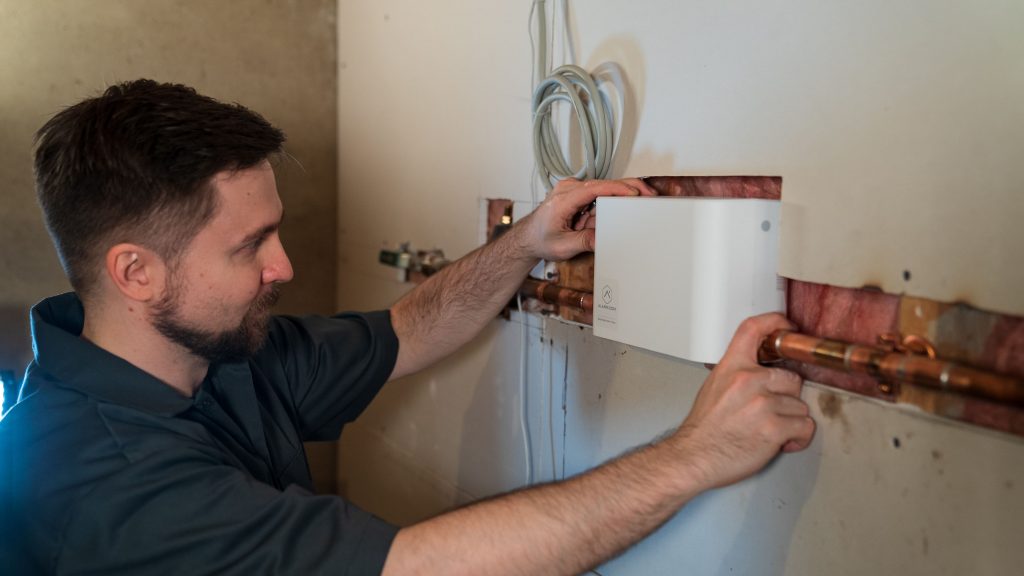
I knew this could be a long-term thing on my very first day, before the HR paperwork was even filled out. They pulled me into a job because of my size — they put me up on someone’s shoulder and shoved me into a hole and handed me a Sawzall. ‘You see that pipe back there? Go cut it.’ I figured, alright, I can do this. From that moment on, it was always an exciting field. Fixing things with my hands and seeing a final product the way tradesmen do — that’s what pulled me in.
From the Field to a Smart Home Company
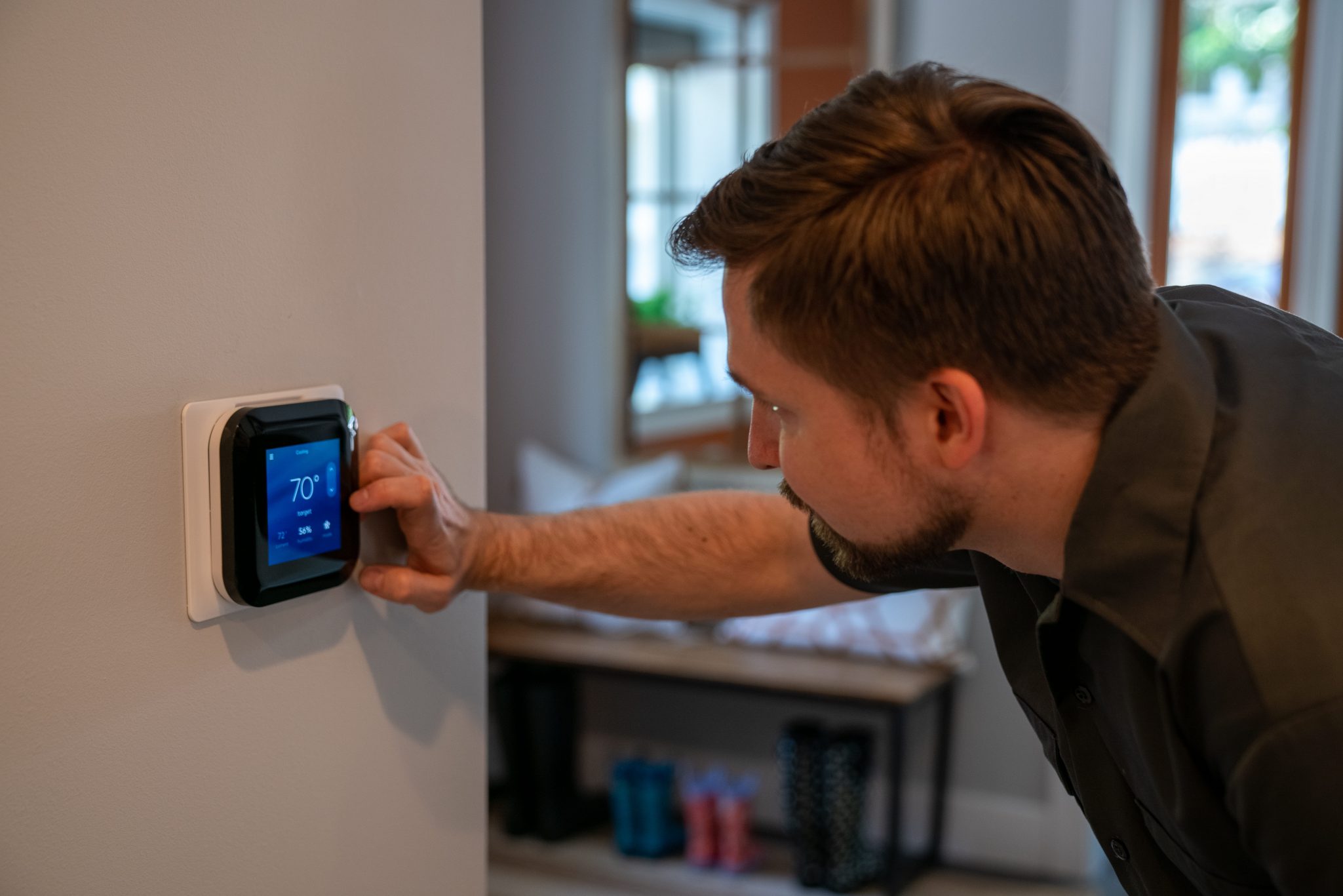
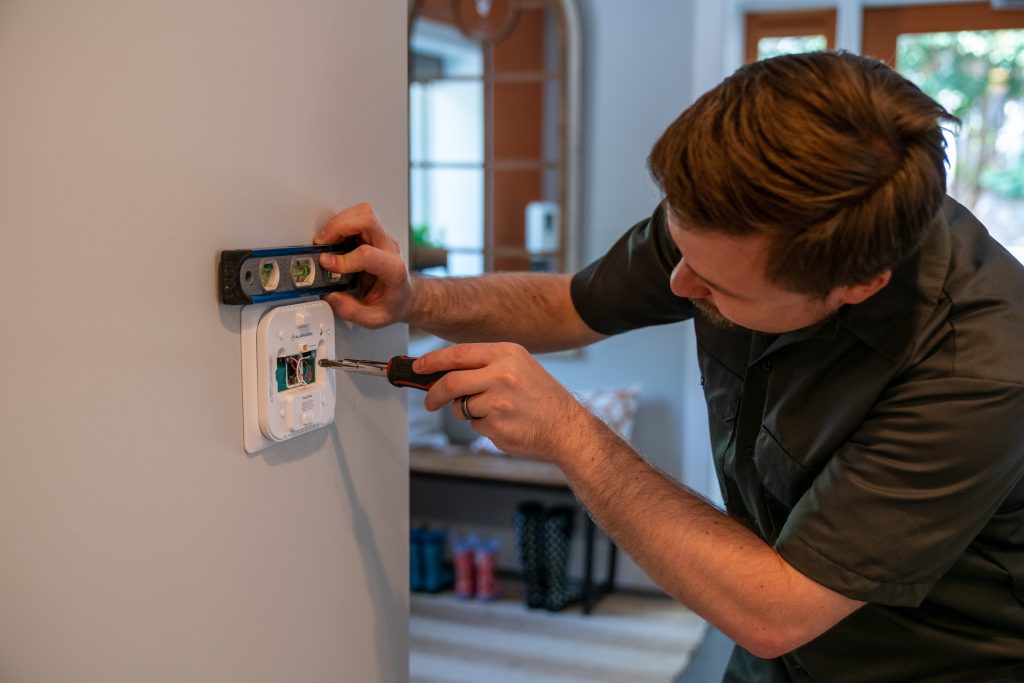
Today I’m a product manager for a smart home company. We build thermostats and smart home devices to empower the trades to stay connected to their customer base — through a branded app and all the things that belong in the home. Unlike other smart home companies, we only sell to the trades. We believe only tradesmen should be installing thermostats, not homeowners.
The transition from the field to product management was difficult at first. I had to learn about delegation, because you can’t just go and code something yourself — you need a software engineer for that. And the overall vibe of the white-collar space is very different from the trades. There’s a little bit of roughhousing in the field, some name-calling. You can’t do that in an office. That was an interesting adjustment.
What surprised me the most was that even big tech companies and small companies — they’re all a little bit chaotic. It’s fascinating that the world is able to do what we do with so much chaos going on around projects and timelines and budgets. Going from the trades into product management, I expected a little more organization, a little more formality. But no — sometimes you just have to push through.
Learning on the Job — Twice
As a technician, the hardest thing to learn was the technical side, because I was learning on the job. I didn’t go to a traditional trade school. I had to figure out airflow in duct work, water flow for boilers, all those things you’d normally learn in a classroom. Google existed but AI didn’t, so it was a lot of books and research at the end of each day.
Similarly in product management, there’s a whole vocabulary and a whole set of processes. I didn’t know what a sprint was, or scrum management, or agile methodology. I didn’t go to product manager school either. So again, I figured it out on the job. The good news is that the troubleshooting methodologies you learn as a service tech apply everywhere. Even if you’re troubleshooting an app feature, you know how to isolate just that feature — the same way you’d isolate components on a furnace.
Service techs talk to homeowners every single day. If you ask a residential HVAC guy how many homes he’s in in a year, it’s going to be two or three a day, five days a week. The numbers add up fast, and with that you build really strong people skills. You have to naturally be comfortable being in someone’s home and making them feel comfortable. That’s a skill I think is underutilized in the trades — people just don’t make that connection or tap into that strength.
The Snowpocalypse Shift
I wouldn’t be a tradesman if I didn’t have a story from the field. The one I always come back to: snowpocalypse hit while I was doing data center work. There were four of us on a twelve-hour shift when it went from no snow to six feet of snow in twelve hours. Virginia just isn’t set up for that kind of snow removal.
We ended up bunkered down for four days. We couldn’t have left even if we wanted to — it took multiple days for a plow to make it back to us. The snow was creating weight concerns on the buildings, so we were getting crews up on roofs. Three of us, three buildings. We made cots in an unused office, one person sleeping while the other two worked, rotating every twenty-four hours. We learned a lot about each other and a lot about patience. And then we all got a week off after, which was nice.
Bells, Clock Towers, and West Point
For about a year and a half I did bell and clock work — repairing church bells and clock towers all over the country. Really cool work, and I saw a lot of things most people never get to see. Probably the most impressive was the church at West Point, the Military Academy. They have a carillon — basically a giant piano for bells — and seeing the size of those bells, eight or ten feet in diameter, standing inside one of them, was something else.
I also worked on a three-hundred-year-old fully mechanical clock that the priest would go up and wind every Sunday. That’s the kind of place us technicians get to go that most people don’t. Whether it’s being shoved into a wall to cut out a pipe or standing inside a bell at West Point — we see a lot of cool things.
Treat Everyone Like a Friend
If I had to put my work philosophy into one phrase, it’s: treat everyone like a friend. If I’m at my desk doing product manager things and a software engineer pops up with a question, I’m going to prioritize it because they’re my friend. If I’m talking to an HVAC technician who’s yelling at me because we did something silly with our product, I tell myself — he’s just having a bad day, friend. Don’t take it personally. Try again tomorrow.
That mindset applied in the trades too. You’re in someone’s home, playing with their dog or cat. If you treat them like a friend, that’s the simplest way to handle the obstacles. My friends have an endearing term they use: ‘everyone needs an Andrew.’ Just yesterday I was helping a friend pour concrete because I know how to pour concrete and he doesn’t. He just texts me — ‘what are you doing tonight?’ Nothing. ‘Want to pour concrete?’ Obviously yes.
Standards, Or the Lack of Them
What I’d really like to see standardized are residential HVAC controls. Honeywell, Lennox, Rheem, they all make their controls a little bit different, which makes building systems more complicated than they need to be. A more standardized residential control would give homeowners more flexibility and more options. Right now, if you want a really efficient system, you have to commit to a specific thermostat. The thermostat is the only homeowner-facing component of the HVAC system — I’d like to see more flexibility and options there.
On the broader trend, the industry is moving in the right direction toward efficiency. The world is using more power and only getting bigger. We’re going to have to hone in on these efficiencies at some point, and the industry is leaning that way.
Work-Life Balance and Rock Climbing
When it comes to work-life balance, I’ll be honest: I’d put this one under ‘needs improvement.’ Right now, work takes up a lot. I’m a direct contact for our customer base — if they have trouble in the field, they’ll call me. We give white-glove service. Because of that, my days start early and end late.
When I’m not working, I rock climb. And of course, I helped the maintenance guy at the rock climbing gym troubleshoot some humidity issues — every building, I’m looking at it through process. Side work is always a thing for tradesmen. Most of my friends who are still HVAC guys are still doing side work, and family work too. My mom’s happiest day was the day I became an HVAC employee. Every time I go home, it’s a list.
Advice to the Next Generation
If you’re thinking about the trades, focus on certifications, not necessarily degrees. Certifications are more practical. An EPA universal certification is much more beneficial than going to college to learn mechanical engineering — unless that’s the path you actually want. Start with a couple of certs, see if the knowledge triggers something, and if it does, dive deeper.
Certifications are becoming much more useful, especially with all the new technology that needs specialized training — inverter techs, for example, are a completely different beast. Getting certified in that kind of tech is probably the best way to dip your toes into the trades.