
The Career I Never Planned
HVAC was part of my life long before it became my career. My father had been in the industry since before I was born, but for pretty much my entire adolescence I told him I would never do the same thing. I never wanted to be an air conditioning guy.
Instead, I went to a four-year college. That wasn’t for me, so I moved on to automotive trade school, became a technician and worked in various roles in the automotive field. HVAC still wasn’t part of the plan.
Then my father called me one day. I was living in Pennsylvania at the time, and he offered me a job and the opportunity to move out to California. I took him up on it, and that’s how I ended up entering the industry around 2014 or 2015.
It’s been more than a decade since then, and I haven’t looked back. Today, I’m Director of Technical Services at Norman S. Wright in Northern California, focusing primarily on variable refrigerant flow (VRF) systems.
Finding the Part of HVAC That Interested Me
Although HVAC wasn’t my first choice, I’ve always been technically minded. I’ve always liked taking things apart, putting them back together and understanding how they work. At the same time, being a kid of the ’90s, I naturally gravitated toward computers.
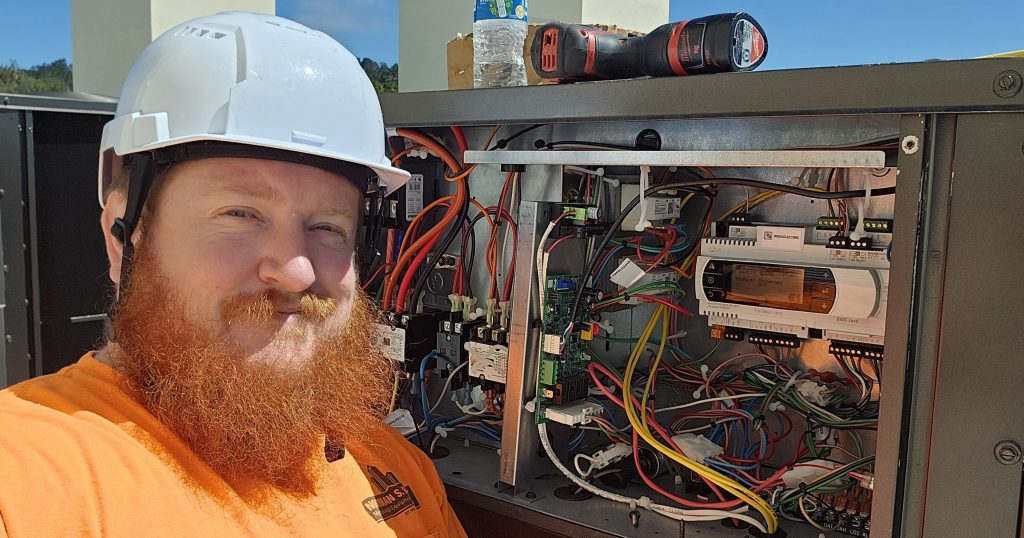
What really drew me into HVAC, and what has kept me interested, is the integration between those two sides: the computer side and the mechanical side.
There’s something really interesting about knowing both at the same time. Once you understand the equipment and understand the controls, you begin to see how you can make an air conditioning system work the way you want it to work, as long as you know how to make the controls work with it.
That combination is also why I’ve continued trying to learn more about controls. I’m not doing as much integration work myself anymore, but I see a lot of value in understanding what the controls vendor is doing while also knowing what should be happening mechanically. Controls specialists aren’t necessarily mechanically inclined, and they don’t always know what they don’t know on that side of the system.
If I can understand both, I can help bring those two worlds together.
Learning to Slow Down
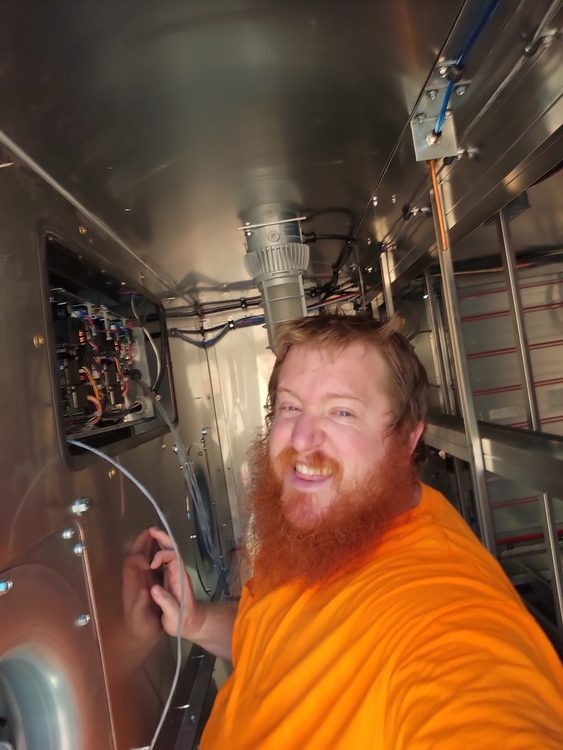
Entering HVAC at around 25 meant I had a large knowledge gap to overcome. I came from the automotive world, where air conditioning was generally one of everybody’s least favorite things to work on, and suddenly I was trying to understand much more complex systems.
One piece of advice from my time as an auto mechanic ended up helping me a lot.
I was working with a master technician and having a difficult time putting something back together. He could see that I was struggling and told me to slow down. “It’s just nuts and bolts. Just put it back together.”
That idea has stuck with me throughout my HVAC career.
The difference between the refrigeration cycle in a car and the one in a VRF system is huge. A car has a relatively simple, single-stage air conditioning system. It isn’t a heat pump. Then you open a VRF machine for the first time and it looks like there are a thousand copper pipes going all over the place.
It can be daunting, but I go back to the same thought: it’s still copper. It’s still nuts and bolts. You can figure it out.
For me, overcoming that complexity has meant slowing down and thinking about what should be happening, what I want to happen and how I can get there.
That’s important because the knowledge gap never really disappears. There’s always more to learn, always somebody who knows something I don’t, and always another piece of equipment that I’m unfamiliar with. Part of my job is making sure I cover all of those bases when I’m helping customers so that everybody wins at the end of the day.
Learning Beyond the Classroom
My progression in the industry has largely come down to a willingness to learn. I take classes, seminars and training whenever I can, but realistically, sitting in front of a PowerPoint for five days can only teach you so much.
You also have to be willing to go out and learn things for yourself.
A big part of that is reading. It’s something I tell younger people who want to enter the trade. Instead of spending the morning doom-scrolling through Facebook or Instagram, open a product manual and read about the equipment.
Then, when something comes up later, you may find yourself thinking, “I read about that the other day.”
That’s how I’ve tried to close the knowledge gap throughout my career: by being willing to keep learning.
It also connects to something I often tell newcomers when they ask what tools to buy. The most important ones aren’t the ones you buy at all. They’re your eyes, your ears, your brain and your hands.
You have to read the problem, listen to the problem and then think about it. To me, critical thinking is the greatest tool there is. Sometimes you simply need to take a second, slow down and think about what’s actually happening.
I don’t like not having the solution, but I’ve learned that working at a hasty pace doesn’t get you there.
Where the Technology Goes Next
The technical side of the industry is also becoming more interesting as the technology evolves.
VRF has been around since the early 1980s, but I think we’re beginning to see the next stage of what’s possible with it. We’re seeing things like water-source chillers and heat pump chillers, and the first time I opened one up, my reaction was that this is just a big VRF that has water instead of air.
What interests me is seeing where inverter technology can take these systems next and how it can make them more efficient and better for the end user.
Refrigerant technology will keep evolving as well, although I don’t think we can get away from refrigerant altogether. You still need some sort of medium. What changes is the medium itself. We’ve gone through R-410A and R-32, and now R-454B is coming through in different phases, and I’m interested to see what the next generation looks like. As long as I can stay away from propane, I think we’ll be fine. R-290 is a great refrigerant, but still.
Eventually, if we reach some sort of medium that is the best it can be, I think the rest of the industry will adapt around it.
The Part I Can’t Predict
On the controls side, the possibilities are much harder to predict.
Historically, I’ve felt that HVAC controls, particularly on the commercial side, were five to ten years behind modern technology. Over roughly the last two years, though, we’ve made significant leaps forward and shortened that gap to about two years behind.
When you look at what is happening with AI platforms, machine learning and language models, it’s hard for me even to imagine how controls could change over the next five years. That’s what makes it exciting.
Data is going to be important as part of that evolution. To me, more data is always good data, because without information you can’t make an assumption or an educated guess about what is wrong with a system. The more useful information we have, the more it can help technicians understand what’s happening.
Ultimately, that can make the technician smarter, and that’s good for everybody.
Because I Can Make It Happen
Some of my interest in controls has no practical justification at all.
In the lab space I work in, we have lighting controls and BACnet controls for the dampers and pretty much everything else. There’s absolutely no need for any of it. I did it because I could make it happen, so it happened.
Programming controllers to do things is just fun. But it also keeps me sharp on the side of the system I care most about understanding, which is where the controls and the mechanical meet.
Turning a Problem Into a Tool
That same interest in understanding and making things doesn’t end with my day-to-day work. I’m also an avid 3D-printing enthusiast, although for me it’s less about the printing itself and more about the design process.
I enjoy starting with a conceptual idea in my head, scribbling some notes on a pad, creating the design in software and then sending it to a device that physically makes it. I really enjoy that process of going from an idea to something tangible.
That interest has also become part of a side business.
The tools technicians need to work on electronic expansion valves were hard to get hold of, hard to find a part number for and relatively expensive. I thought there was definitely a better way to do it, and that this was something we could solve for pennies on the dollar.
My business partner originally came up with the idea for the tool back in 2020, when he was furloughed, and he built it. The result is EEV Mate: a small magnet that lets technicians open and close electronic expansion valves manually rather than relying on the control board. Today, I probably print 30 to 40 of them a month.
What began with one tool has gone much further than we expected. Six years later, we’ve sent tools to around 27 countries. I recently dropped off two that were heading in completely different directions: one to Canada and another to Great Britain.
It’s been interesting to see how something created to solve a specific technical problem has traveled all over the world.
The Places HVAC Takes You
Another interesting part of working in this industry is getting access to places and equipment that most people never see.
I remember working in a building from the 1930s where, to reach the HVAC equipment, we had to pass through a mechanical mezzanine. It was essentially a half-floor between the top floor and the roof, and inside there were two original DC elevator motors, each about the size of a small desk. It was one of the coolest things I’d come across in a while, and it wasn’t even really HVAC.
Another memorable project was at a 2K Sports studio, where they do all the motion capture work. I couldn’t take any pictures, but from the outside it was just a fairly unassuming building somewhere in California. Once inside, there were signed pictures of famous athletes, race car drivers and all kinds of people connected with the sports games they had produced.
What interested me was getting to see the behind-the-scenes side of it, and the equipment that supports everything happening in a place like that.
Being Truthful About the Problem
If there’s one personal value I try to bring to my work every day, it’s being truthful.
My customers come to me because their clients have a problem, and telling somebody something that isn’t true doesn’t solve anything. Whether I find a poor installation practice, an issue with the equipment or something else entirely, I think I need to be open about what I’m diagnosing and talk honestly about the problem.
When Work Is Done, Work Is Done
I also try to keep work in perspective. That’s not always easy when even my side business is directly related to VRF, because sometimes it feels like the industry never stops.
But you have to be strong-willed enough to say that when you’re done with work, you’re done with work. There’s really no replacement for time with your family, because once that time is gone, it’s gone. You have to be mindful about actually stopping when the day is done.
And when I think about what I might be doing if HVAC had never become my career, I come back to the same curiosity that has followed me through automotive work, controls and 3D printing.
I’ve told my wife I’d probably want to be a starving inventor, like the inventors of the past. People such as Edison and Tesla, just trying to come up with a better idea. That’s where I think I’d feel comfortable: trying to invent something that makes life better for somebody else. It isn’t a very lucrative job, but we’d figure that out.
In some ways, that’s already part of what I enjoy doing today.
Don’t Be Afraid to Try
My father has been a big mentor to me throughout my career, and there are also people at Norman S. Wright I still rely on when I come across the really problematic stuff.
After all these years, though, much of the advice I come back to is remarkably simple: slow down.
There’s always going to be something you don’t know, particularly in an industry that keeps evolving. You can’t let that stop you from trying to understand it.
So if someone asked me what they should do to get into HVAC or learn a new part of the industry, I’d tell them to jump in and learn about it. Put your hands on it if that’s how you learn. Don’t be afraid of it.
There’s nothing to be gained if you don’t try.